
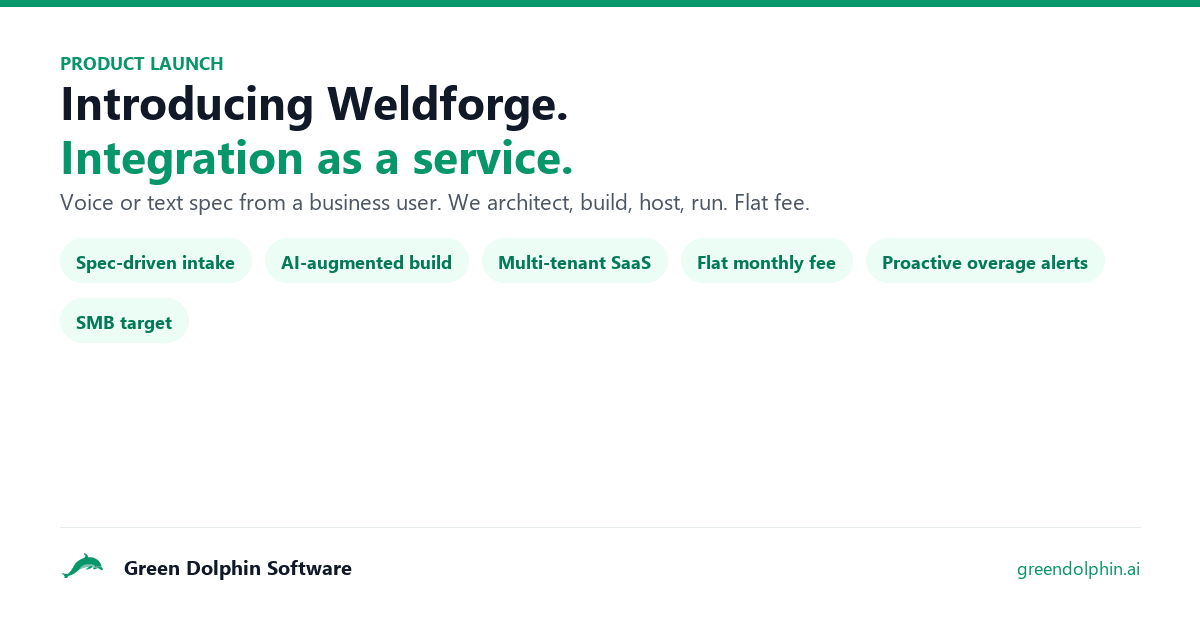
Introducing Weldforge: spec-driven integration as a service for SMB
by Green Dolphin Software, Integration practice
After 25 years of building enterprise integrations under our own banner, we kept hearing the same three things from SMB founders, ops leads, and finance directors:
- "I don't want to learn another platform."
- "I don't want to pay per operation and watch the bill creep."
- "I just want the thing connected so I can stop worrying about it."
Existing iPaaS (Workato, Boomi, Tray, MuleSoft, Make, Zapier) is optimized for a different buyer: an enterprise with an internal platform team that can adopt, train, build, and operate. SMBs don't have that team. And they shouldn't need one.
So we built Weldforge — a SaaS product that takes the Green Dolphin consulting delivery model and turns it into a subscription.
What Weldforge is
A spec-driven integration platform.
- A business user submits an integration spec by voice or by short form on the Weldforge intake UI: from system, to system, frequency, data shape, success criteria, deadline. Two minutes.
- Weldforge confirms scope back to the customer, shows the flat monthly cost up front, and quotes a build timeline.
- We architect, build, host, and run the integration inside Weldforge's multi-tenant cloud. The customer never sees MuleSoft, Workato, Boomi, Zapier, or any other underlying platform.
- The customer watches it work via built-in real-time dashboards — jobs run, errors, latency, throughput, projected cost.
- Proactive overage alerts fire at 70 / 85 / 100 percent of plan. No customer ever receives an invoice larger than their subscription without one-click written approval.
Pricing — built for SMB
| Tier | Monthly | Annual (20% off) | Integrations | Events / month |
|---|---|---|---|---|
| Spark | $499 | $399/mo ($4,788/yr) | 2 | 50,000 |
| Forge (most popular) | $1,499 | $1,199/mo ($14,388/yr) | 6 | 500,000 |
| Foundry | $3,999 | $3,199/mo ($38,388/yr) | 15 | 3,000,000 |
These prices were set after benchmarking against 14 incumbent iPaaS pricing sheets. The summary: Weldforge is generally 50–80% cheaper than a Workato or Boomi engagement on a comparable scope, because the customer is not paying for a platform license they have to staff up to operate. They're paying for the integration that runs.
Founders' tier: First 50 paying customers get Forge features at the Spark price ($499/mo) locked in for 24 months. The counter is public on the pricing page.
Why this is different
Three things, none of which are advertising-language:
- Business-user-centric, not IT-centric. The customer is a marketing lead, a finance director, an ops manager. Weldforge's UI is a voice recorder and a six-field form. There is no Anypoint Studio to download. No recipe canvas to learn. No webhook URL to copy. The build artifacts live in our cloud, not yours.
- Spec-driven, not connector-driven. Other platforms make you compose pre-built connectors. Weldforge starts from the customer's stated outcome — "Salesforce contacts into NetSuite customer records, daily, dedupe on email" — and builds whatever the right platform combination is to deliver that outcome. Often it's MuleSoft. Sometimes Workato. Sometimes a custom Python service. The customer doesn't care, and they shouldn't have to.
- Predictable, not metered. Flat fee monthly or annual. Overage alerts at 70 / 85 / 100 percent. No silent invoices, no per-task multipliers, no surprise tier upgrades.
Multi-tenant from day one — security is the constraint, not the afterthought
Weldforge is multi-tenant SaaS. Hard tenant isolation is the design constraint that overrides every other architecture decision.
- Data isolation: every record carries a tenant identifier; row-level security on every read; per-tenant Data Encryption Keys envelope-encrypted under a Weldforge KMS master key. A bug in the application layer cannot leak data across tenants because the database itself refuses the cross-tenant read.
- Secrets isolation: customer OAuth tokens, API keys, and connection credentials are stored per-tenant, encrypted at rest with the tenant's own DEK, never accessible to another tenant's integration runtime even in a misconfigured deploy.
- Runtime isolation: when a Weldforge integration runs, it executes inside a tenant-scoped sandbox with IAM scoped to that tenant's secrets and network egress allow-listed to that tenant's declared destinations. A buggy integration cannot reach another tenant's data even if it tried.
- Observability isolation: logs, metrics, traces are tenant-tagged at write time. Customer dashboards filter by tenant; support tools require an audited proxy step to access tenant data, and that access is logged to the tenant's own audit feed.
The full security architecture is on weldforge.ai — and the SOC 2 path is on the roadmap with target Type I evidence collection starting in early access.
What this means for existing Green Dolphin clients
Nothing changes for our existing Fortune 500 engagements. Green Dolphin remains the senior-architect-led consultancy that delivers $25K–$100K+ fixed-bid SOWs on MuleSoft, Workato, Boomi, Salesforce, NetSuite, and the broader integration stack. Weldforge is a separate product line targeted at a different buyer (SMB ops/marketing/finance), at a price band that doesn't make sense for an SOW engagement.
If anything, Weldforge is a referral channel: when an SMB lead doesn't have $25K to spend on a one-off MuleSoft project but does have $499/mo, the right answer is now Weldforge, not "you're too small for us."
Early access
Weldforge intake is open at weldforge.ai/intake. Drop your email and a one-line description of what you want connected. We respond within one business day with a scope confirmation and a founder-pricing offer.
If you'd rather talk to a human first, email max@weldforge.ai or hello@weldforge.ai. The whole thing is built by the same team that's been doing this work under the Green Dolphin banner — just productized.
— Max Girin, founder