
Celigo vs Boomi vs Workato vs MuleSoft: how to actually choose
by Green Dolphin Software, Integration practice
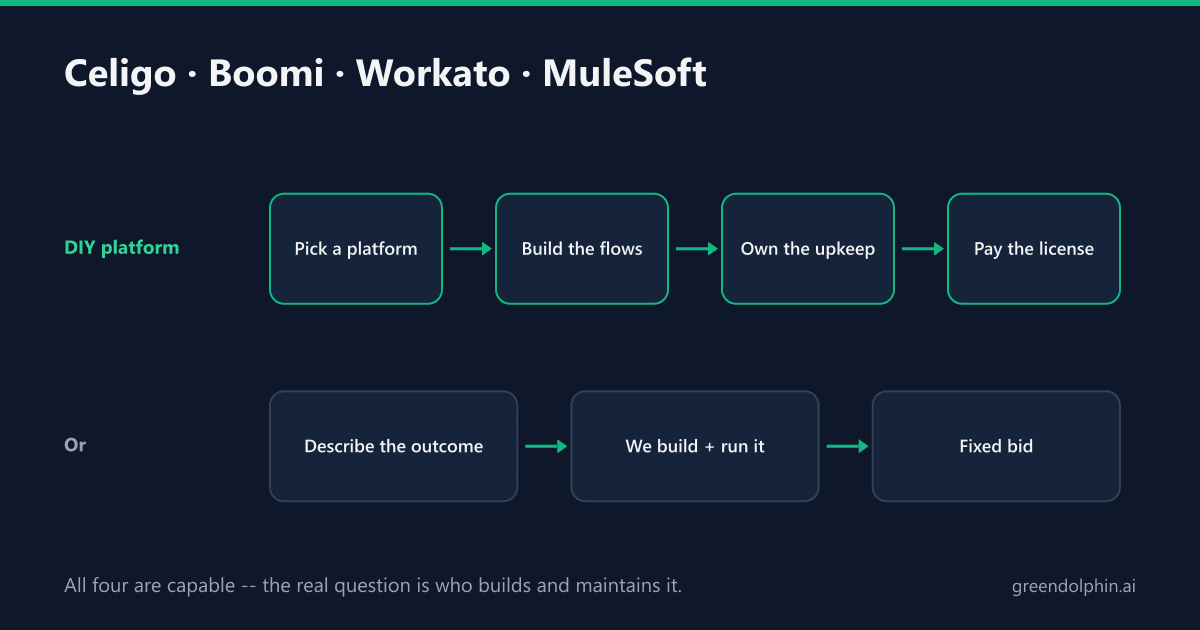
"Celigo vs Boomi vs Workato vs MuleSoft" is one of the most common shortlists we see — and the forum threads comparing them almost always argue about features. After 25 years of doing this, the feature list is rarely what decides the outcome. The real question is who builds the flows, and who maintains them when an API changes. That is where the cost actually lives.
The honest one-liner on each
- Celigo — strong prebuilt integration apps, especially around NetSuite. Fast when your use case fits a prebuilt flow; custom logic and edge cases still land on your team.
- Boomi — a capable, broad enterprise iPaaS. Assumes you have Boomi-trained developers and pay platform licensing on top.
- Workato — a mature low-code recipe builder, increasingly the destination teams move to. Bills by task/recipe usage, so cost grows with volume, and someone owns building and maintaining the recipes.
- MuleSoft — enterprise-grade, API-led, powerful — with pricing and a learning curve to match, and it expects in-house Mule developers to build and run the flows.
Side by side
| Celigo | Boomi | Workato | MuleSoft | |
|---|---|---|---|---|
| Cost model | Subscription + prebuilt apps | License + dev effort | Usage (per task/recipe) | Enterprise license + devs |
| Sweet spot | NetSuite-centric, fits prebuilt | Broad enterprise iPaaS | Mid-market, low-code ops | API-led at enterprise scale |
| Who builds it | You (or a partner) | Your Boomi devs | Your ops team | Your Mule devs |
| Who maintains it | You | You | You | You |
| Learning curve | Low–medium | Medium | Low–medium | High |
The factor the threads miss
Notice the bottom two rows of that table are identical across all four: you build it, you maintain it. The platform is only ~20% of the total cost of an integration. The other 80% — reconciling data models, handling the edge cases, and fixing it at 2am when an API changes — is yours regardless of which logo you pick. That is why "which tool is best?" is the wrong first question.
How to actually choose
- If you have a platform team already (Mule or Boomi developers on staff, or strong ops people for Workato), pick the one your team knows and budget for ongoing maintenance.
- If you are NetSuite-centric and fit the prebuilt flows, Celigo will get you live fastest.
- If you do not want to own the build or the upkeep at all, the honest answer is that none of these four solve that — they are tools, not outcomes.
That last case is the one we built Green Dolphin for. You describe the outcome; we return a fixed-bid statement of work, build it on the right technology for your situation, and run it — so the 80% that usually lands on your team lands on ours instead. Compare us directly: vs Celigo, vs Boomi, vs Workato, vs MuleSoft — or start your intake.