
MuleSoft Center for Enablement (C4E) Playbook: Crossing the 30-API Wall
by Green Dolphin Software, Integration practice
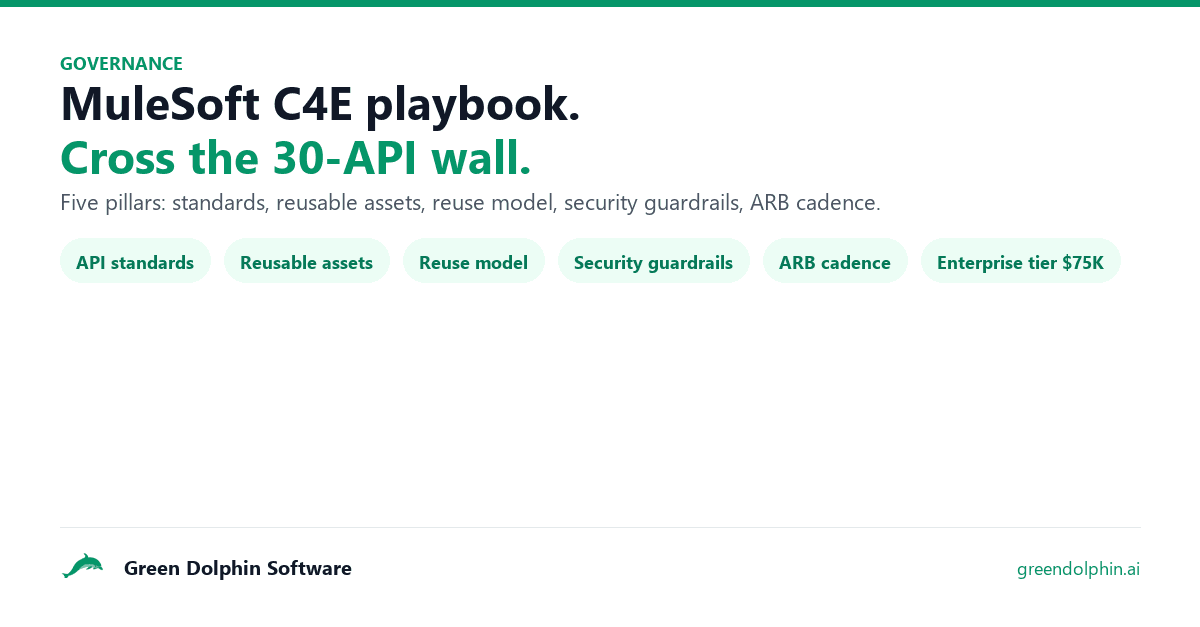
Most MuleSoft estates we walk into have a familiar shape. The first 10 APIs were built by one or two senior architects who knew what they were doing. The next 20 were built by a growing team that mostly followed the same conventions. Somewhere around API #30, the wheels come off — and not because anyone did anything wrong.
The wall is governance debt. Five teams have shipped APIs. Three different naming conventions exist. Two competing canonical models. Error-handling patterns differ enough that incident response is harder than it should be. New teams reinvent connectors that already exist somewhere. Reuse becomes accidental, then nonexistent.
This is the problem the Center for Enablement (C4E) framework solves. Done right, C4E is the difference between a MuleSoft estate that scales to 200+ APIs and one that gets quietly abandoned and replaced.
What a real C4E actually provides
A useful C4E is built on five pillars. Any of them missing, and the rest underdeliver.
1. API design standards
A written, enforced standard for how APIs are designed across the org:
- RAML 1.0 / OpenAPI 3.x conventions (which one, with what extensions)
- Naming: resource paths, query parameter casing, header conventions
- Versioning: URL path vs header, deprecation policy, sunset cadence
- Error model: HTTP status code use, error body schema, correlation IDs
- Pagination: cursor vs offset, default page size, max page size
- Auth: token format, scope conventions, identity propagation
Standards live in a single shared document, get version-controlled, and the Architecture Review Board (Pillar 5) checks new designs against them.
2. Reusable assets
The library of things teams should reuse instead of rebuild:
- API templates per common pattern (Process API skeleton, System API skeleton, Experience API skeleton)
- DataWeave libraries for shared transformations (date math, currency conversion, masking)
- Error handling frameworks (consistent retry, dead-letter, alerting)
- Connector property templates (timeouts, circuit breakers, observability)
- Postman / smoke-test collection templates
- CI/CD pipeline templates per asset type
Each reusable asset has an owner, a deprecation policy, and a discovery mechanism (Pillar 3).
3. Reuse model
How new teams find and consume existing assets. This is where most C4E implementations fail. A repository of assets that nobody knows about is no better than no assets at all.
The reuse model has three parts:
- Discovery: a searchable Anypoint Exchange + internal docs landing page with current asset inventory
- Consumption: clear path to use each asset (template snippet, copy-paste config, dependency pin)
- Contribution: how teams propose new assets, get them reviewed, and get them adopted
Reuse model failure mode: assets exist but nobody finds them, so teams build their own. Solution: every new API project starts with a 15-minute Exchange browse before any code is written.
4. Security guardrails
Cross-cutting controls that apply to every API the estate ships:
- AuthN/AuthZ patterns (which IDP, which protocol per consumer type)
- Secret management (where, rotation cadence, audit log)
- Data classification (PHI / PII / cardholder / public — and which APIs touch each)
- Encryption at rest + in transit standards
- Rate-limiting per consumer tier
- Audit log retention
Security guardrails are NOT a separate document — they are baked into the API standards (Pillar 1), the reusable templates (Pillar 2), and the ARB checklist (Pillar 5).
5. Architecture Review Board cadence
The mechanism that keeps the previous four pillars from drifting:
- Weekly or biweekly ARB meeting (45 minutes, async-first prep)
- New API designs reviewed against the standards before build
- Quarterly retrospective on which assets are actually being reused vs ignored
- Annual review of standards themselves (what to add, deprecate, change)
- Membership rotates across teams so no single team owns the standard
ARB is the human pillar. Without it, the other four become a binder on a shelf.
What C4E is NOT
Three failure modes we see often:
Not a central team that approves everything. A C4E that becomes a gatekeeping bottleneck has misunderstood the goal. The job is to make the right thing the easy thing, not to be the only thing.
Not vendor-mandated process. MuleSoft (and other iPaaS vendors) ship suggested C4E playbooks. Use them as input, not as truth. The standards belong to your organization, not the vendor.
Not a one-time PowerPoint exercise. Setting up a C4E once and walking away guarantees drift. The ARB cadence (Pillar 5) is what makes the rest survive.
When to stand up C4E
The right time to invest in C4E is usually before the 30-API wall, but the trigger we see most often is one of these:
- You have 5+ integration developers working in parallel across 2+ teams
- Patterns are visibly drifting (different naming, different error handling, different deploy practices)
- New team onboarding takes longer than it should because there is no "this is how we do APIs here" doc
- A platform migration is on the horizon and you need a clean baseline first
- Audit pressure (SOX, HIPAA, FedRAMP) is pushing for documented governance
If two or more of these apply, the C4E investment pays back in a quarter.
How we deliver C4E
Green Dolphin ships C4E governance as part of the Enterprise tier ($75,000, ~8 weeks). The deliverable is a framework the client team can run with after we leave — not a binder, not a process we own forever.
Included:
- Written API design standards (RAML/OAS conventions, naming, versioning, error model, auth)
- 5-7 reusable asset templates (API skeletons, DataWeave libs, error frameworks)
- Anypoint Exchange asset catalog seeded with the initial templates
- Reuse-model documentation (discovery, consumption, contribution flows)
- Security guardrails baked into templates + a documentation overlay
- ARB charter, cadence, and 12 meeting templates
- 2-3 design reviews of in-flight projects against the new standards
- Internal launch deck + 90-minute kickoff training for engineering leadership
- Quarterly retrospective playbook for ongoing maintenance
If the scope is broader (platform implementation + C4E + AI layer together) it consolidates into the Enterprise tier. If C4E alone is the engagement, scope reduces to ~6 weeks and $50K Standard tier.
Common adoption objections (and how to handle them)
"We do not have time for governance overhead." Real answer: ARB consumes 45 min/week from each member. Reusable assets save 5-15 hours per team per API. ROI breaks even at API #3.
"This is just vendor lock-in to MuleSoft." The standards (Pillar 1) and the reuse model (Pillar 3) are platform-agnostic. If you migrate off MuleSoft later, 80% of the C4E artifacts survive the migration.
"We tried this once and it died." Almost certainly because there was no ARB cadence (Pillar 5). Standards without enforcement is just a wish list.
Concrete next step
If the 30-API wall is visible or already in front of you, the Enterprise tier engagement is $75K fixed-bid, ~8 weeks, lands a working C4E + framework documentation + 2-3 in-flight design reviews.
If you are smaller (10-20 APIs, 2-3 developers, no immediate audit pressure), the $25K Architecture & Design engagement returns a written governance recommendation + a 90-day rollout plan you execute yourselves.
Start the 6-step intake and we return a fixed-bid SOW within 3 business days. See also the enterprise integration playbook and the vendor comparison framework.